
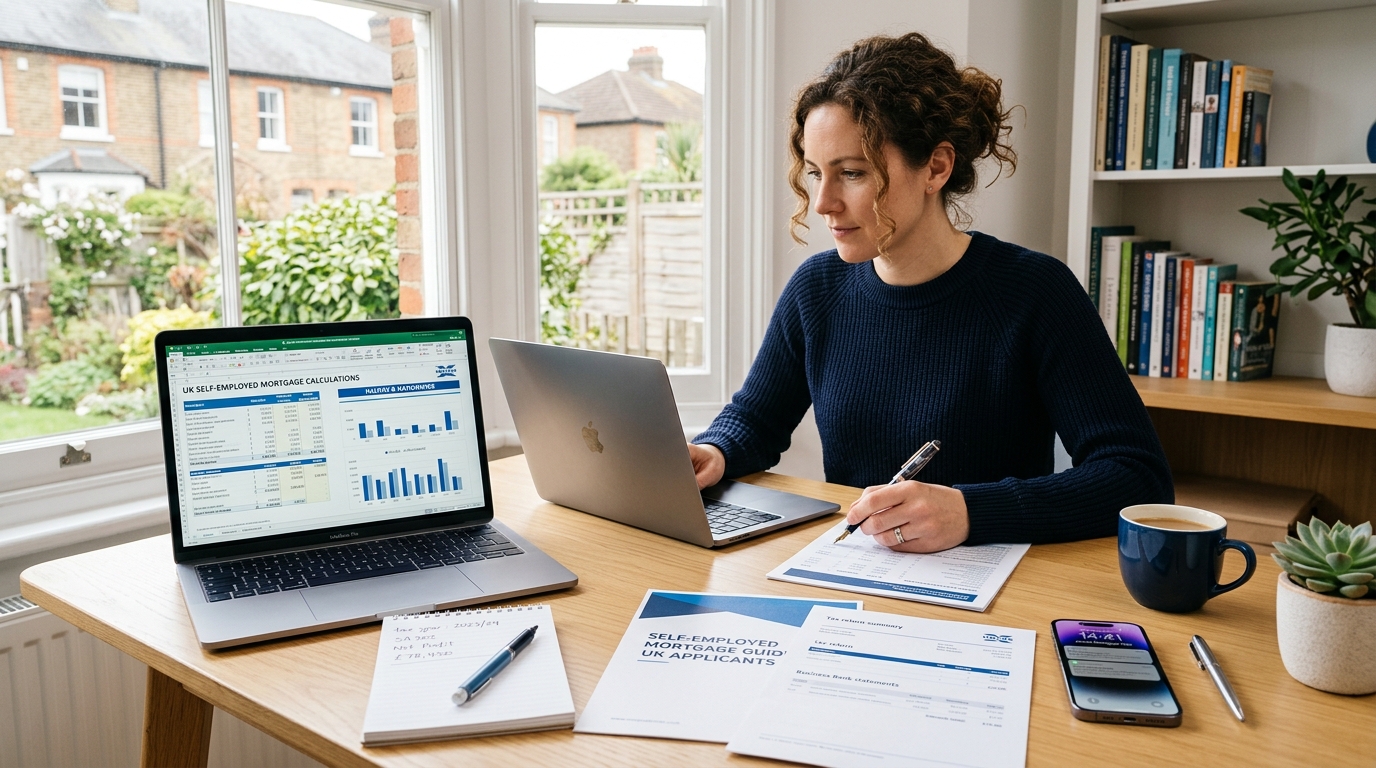

Securing a mortgage when you are self-employed is often thought to be significantly harder than applying as an employed borrower. While lenders do assess self-employed income with greater scrutiny, the mortgage products, interest rates, and loan terms available to you are fundamentally the same as those offered to any other homebuyer in the UK.
The real difference lies in how mortgage lenders verify and calculate your income. Whether you operate as a sole trader, limited company director, contractor under the Construction Industry Scheme (CIS), or partner in an LLP, having a clear understanding of what documentation lenders look for will ensure your application goes through without unnecessary delays.
What is a self-employed mortgage?
In the UK mortgage market, there is no separate legal category of loan called a “self-employed mortgage”. Self-employed applicants apply for the exact same fixed-rate, tracker, and variable mortgage deals as salaried employees. The distinction is strictly administrative: whereas a PAYE employee proves their earnings with a few consecutive payslips and a P60, a self-employed borrower must demonstrate trading history, profitability, and sustainable drawings through accounts or HMRC tax documents.
How lenders calculate self-employed income
Different lenders calculate your borrowing capacity differently depending on your legal business structure:
1. Sole Traders & Freelancers
Lenders look at your net profit after allowable business expenses, as declared on your HMRC Self Assessment tax return. Most high street and specialist lenders average the net profit across your last two to three years of trading. If your net profit has risen steadily year-on-year, an average is usually taken. If profits dropped in the most recent tax year, lenders will typically base their affordability calculation on the lower, recent figure.
2. Limited Company Directors
If you own 20% to 25% or more of the shares in your limited company, virtually all UK mortgage lenders will classify you as self-employed. Lenders assess company director income in two primary ways:
- Salary plus Dividends: The most common assessment method among mainstream high street lenders. Affordability is calculated from the salary you draw plus the dividends actually distributed to you.
- Salary plus Share of Net Retained Profit: Many business owners intentionally retain profits inside the company for tax efficiency or reinvestment rather than drawing them down as dividends. Specialist lenders will take your director’s salary plus your proportional share of the net post-tax company profits, allowing you to borrow considerably more.
3. CIS Contractors (Construction Industry Scheme)
Self-employed tradespeople and construction workers operating under HMRC’s Construction Industry Scheme are subject to 20% tax deductions at source. A traditional self-assessment review might under-represent true borrowing power. Fortunately, specialist CIS mortgage lenders calculate your income based on your gross contract day rate or gross monthly pay vouchers (typically over the last 3 to 12 months), treating your earnings much more like an employed contract workerBorrowers who work on a contract basis. More.
4. Partnerships & LLPs
If you are a partner in a traditional partnership or Limited Liability Partnership (LLP), lenders assess your individual share of the partnership net profits, proven via your partnership tax return (SA800) and your individual SA302.
How many years of accounts do you need?
Standard industry expectations for self-employed mortgage applications:
- 2 to 3 Years of Accounts: The gold standard. Gives you access to virtually 100% of high street lenders, providing the widest choice of competitive mortgage interest rates.
- 1 Year of Accounts: An increasing number of lenders now consider applications with just 12 months or one completed year of trading, particularly if you worked in the same industry or trade as an employee prior to going self-employed.
- Under 1 Year / Newly Self-Employed: Possible with select specialist lenders or niche commercial providers if you have signed forward contracts, significant industry track records, or substantial cash reserves.
What documents do you need to provide?
Preparing your financial paperwork before submitting an application avoids processing bottlenecks. The standard documentation package includes:
- SA302 Tax Calculations & Tax Year Overviews: Downloaded directly from your HMRC online tax account or requested through your accountant (covering the last 2 to 3 tax years).
- Certified Accounts: Full finalized business accounts prepared and signed off by a qualified chartered accountant (ACA, ACCA, CIMA) or certified accountant.
- Bank StatementsA record of a borrower's financial transactions often requir... More: 3 to 6 months of personal bank statements, alongside 3 to 6 months of consecutive business bank statements showing trading activity.
- Proof of DepositEvidence that a borrower has the required deposit to purchas... More & Identification: Valid passport or driving licence, proof of current address (utility bill or council tax statement within 3 months), and bank statements proving origin of deposit funds.
How much can a self-employed applicant borrow?
Borrowing capacity for self-employed applicants typically follows the standard income multiples seen across the UK mortgage market — usually between 4.0 and 4.5 times annual verifiable income, stretching to 5.0 or 5.5 times for applicants with strong credit ratings, low outstanding debts, or larger deposits (15% to 25%+).
In addition to income multiples, lenders run a mandatory stress test to confirm you can comfortably manage repayments even if benchmark interest rates rise. Existing credit commitmentsAny existing financial commitments, such as credit card or l... More, car finance agreements, student loansLoans that are taken out by students to finance their educat... More, and child care costs are factored into your disposable monthly income.
Steps to improve your approval chances
- Use a qualified accountant: Mortgage underwriters strongly favour accounts prepared and verified by certified or chartered accountants.
- Avoid heavy aggressive tax deductions right before applying: Writing off all profits to minimize Corporation Tax or Income Tax directly suppresses the net profit figure lenders use to calculate your mortgage size.
- Check and clean your credit score: Obtain full copies of your credit files across Experian, Equifax, and TransUnion (e.g. through Checkmyfile) to resolve any errors or missed payments.
- Work with a whole-of-market broker: Because criteria for self-employed borrowers vary drastically between high street and specialist lenders, an independent whole-of-market adviser can place your application with the specific lender that calculates your income most generously.
Related guides on specialist income types
- Can I get a mortgage using latest year’s accounts?
- Mortgage with overtime income: How lenders calculate it
- Mortgage on temporary contract: Complete worker guide
- Zero-hour contract mortgages in the UK
- First-time buyer mortgage schemes guide
- Meet mortgage adviser Damian Youell

Damian Youell
Read independent client feedback and verified reviews for Damian and the NeedingAdvice.co.uk team below.